
Connecting the Pipeline: Higgsfield, Blender and ChatGPT

Updated: 4 days ago
September 29, 2026
Recently at Journeyman Entertainment, we took an important step toward building a more integrated AI filmmaking pipeline: we installed the Higgsfield plugin directly into Blender and began testing the connection. It may sound like a relatively small technical milestone, but for us it represents something considerably larger.
Our goal is to move beyond creating AI-generated shots as isolated images and clips. We're working toward a production environment where the filmmaker can establish a world, control its geography and cinematography, and then use generative AI to help turn those decisions into finished cinematic imagery.
Why Blender?
One of the biggest challenges we've encountered in AI filmmaking is continuity and spatial control. Generative models can create extraordinary individual images, but filmmaking requires much more than an extraordinary image. A location has geography.
A building has a front, back, north wall and south wall. Characters have to move through that environment consistently. Cameras need to be placed deliberately, and reverse angles need to make geographic sense. Blender potentially gives us that foundation.
By constructing or representing an environment in 3D, we can establish camera position, camera height, lens choice, perspective, architectural relationships and the placement of important objects before generating the finished shot.
The objective isn't necessarily for Blender to produce the final photorealistic frame. Instead, we're exploring whether it can provide the structural and cinematographic foundation from which that frame is created.
Bringing Higgsfield into Blender
Today's work began by opening the Higgsfield plugin for Blender, installing it and starting the testing process to confirm that the integration is functioning correctly.
We're deliberately taking this one step at a time. Before incorporating the workflow into an actual production, we want to understand what information can pass reliably between Blender and Higgsfield, how accurately the generated results respect the scene and camera information we establish, and where additional creative intervention is required.
Those tests will ultimately be more important than simply proving that the software connects.
We want to know whether the workflow gives a filmmaker more control.
Where ChatGPT Fits
ChatGPT has become another part of this experiment.
Its role is not simply writing prompts. We're exploring how it can function as a bridge between creative filmmaking decisions and increasingly technical production tools.
A director might describe a shot in traditional cinematographic terms: where the camera should be, what lens we want, where the actor should look, what should appear in the background and how that shot relates geographically to the shots surrounding it.
ChatGPT can help translate those intentions into the technical instructions required by different parts of the pipeline, assist with troubleshooting, and help us maintain the enormous amount of continuity information that accumulates during a feature production.
That creates an interesting three-part relationship:
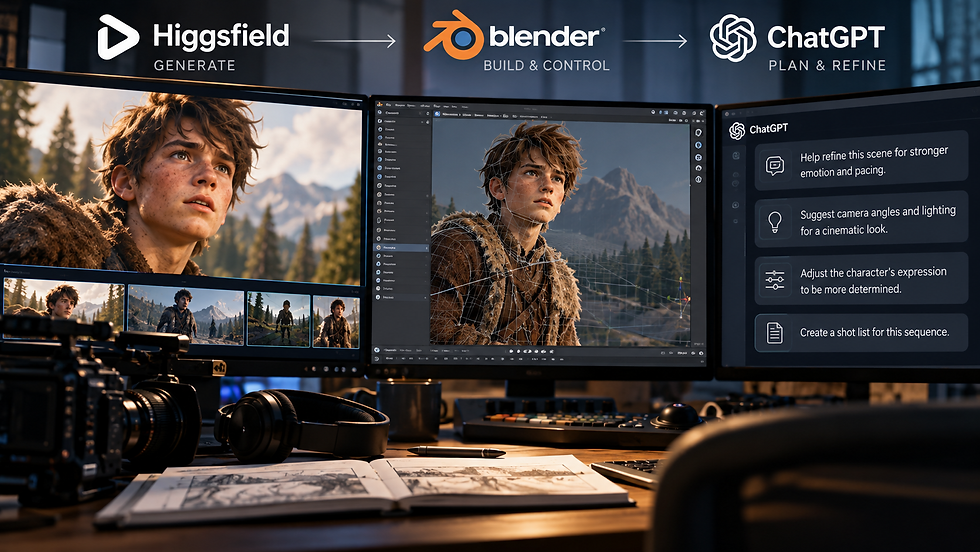
Blender establishes the world and the camera.Higgsfield generates the cinematic imagery.ChatGPT helps connect the creative and technical processes.
We're only beginning to test how far that relationship can go.
The Bigger Objective
Our aspiration isn't to automate filmmaking.
It's to make AI filmmaking more like filmmaking.
Traditional production is built around intentional decisions: production design establishes the world, cinematography determines how we see it, actors create performances, directors shape those elements, and editors determine how the resulting shots work together.
We believe professional AI filmmaking will ultimately require many of those same disciplines.
What changes are the tools.
If this workflow develops the way we hope, we could eventually build a location in three dimensions, establish its geography, position a virtual camera precisely, select a lens and composition, and then use generative technology to transform that foundation into a finished cinematic shot.
More importantly, we could return to that same environment for another shot—and another—while preserving the underlying geography and visual logic of the scene.
For a feature-length AI film, that kind of repeatability could be enormously important.
Testing Begins
That's where we are today.
The Higgsfield plugin is installed in Blender. We're testing the integration and making sure the individual components work before asking the pipeline to do anything ambitious.
There will undoubtedly be limitations, failures and discoveries along the way, and we intend to document those as well.
Because the interesting story isn't simply what today's AI tools can generate.
It's whether filmmakers can turn those tools into a repeatable, controllable production system capable of making a feature film.
That's the experiment we're beginning.
Recently at Journeyman Entertainment, we took another step toward something we've been working toward for some time: an AI filmmaking workflow that behaves less like a collection of separate applications and more like an integrated production environment.
The focus now is the relationship between Higgsfield, Blender and ChatGPT—three very different tools that can become considerably more powerful when each is assigned the job it does best. Higgsfield gives us a generative environment for creating cinematic imagery and motion. Blender provides something generative video still struggles to deliver consistently: a controllable three-dimensional world with measurable camera positions, lenses, geometry, spatial relationships and repeatable viewpoints. ChatGPT serves as the connective layer—helping us develop the workflow, translate creative intentions into technical instructions, troubleshoot problems and maintain continuity across the production.
Why Blender matters
One of the persistent challenges in AI filmmaking is spatial continuity. Generating a beautiful individual shot is increasingly possible. Generating shot after shot while maintaining the precise geography of a location is much more difficult.
Where exactly is the house in relation to the barn? Which direction does a character walk when leaving the front door? Where should the camera be positioned for the reverse angle?
What should be visible through a particular window? If we return to the same location twenty shots later, will the geography still make sense? A 3D environment gives us a way to establish those answers before asking an AI model to create the finished image. Rather than asking generative AI to reinvent the world for every shot, our goal is to use Blender to establish the underlying physical reality of the scene. Camera position, focal length, elevation, direction, architecture and major environmental features can all become deliberate production decisions. Blender doesn't necessarily have to create the final image.
It can create the spatial truth behind the image.
Higgsfield becomes the cinematography layer
Once that spatial foundation exists, Higgsfield can concentrate on what generative filmmaking does particularly well: creating the finished cinematic world.
A relatively simple Blender reference can define composition and perspective while Higgsfield supplies the photographic realism—the actors, atmosphere, period detail, vegetation, weather, lighting, textures and all of the subtle imperfections that make an image feel photographed rather than constructed. That changes the nature of prompting.
Instead of repeatedly asking an AI system to determine both what the world looks like and where everything is located, we're beginning to separate those decisions.
Blender handles geography.
Higgsfield handles cinematic realization.
And the filmmaker remains responsible for both.
ChatGPT as part of the production workflow
The third component is ChatGPT. We're exploring its role not simply as a prompt-writing tool, but as something closer to a technical and creative production assistant. During development, there are hundreds of decisions that need to remain consistent: character specifications, camera directions, location geography, lens choices, shot relationships, continuity rules, naming conventions and the increasingly complex instructions required by different generative models.
The aspiration is for ChatGPT to help connect those decisions across the pipeline.
That means being able to discuss a shot creatively—then translate that conversation into the language required by Blender, Higgsfield or another production tool. It also means helping diagnose why something isn't working and preserving the production logic as the project grows.
The larger goal
We're not trying to eliminate traditional filmmaking disciplines.We're trying to bring them into AI filmmaking. Directing, cinematography, production design, editing, sound design and performance remain fundamental. The tools are changing, but the need for intentional creative decisions isn't.
Our long-term goal at Journeyman is to build a production pipeline in which AI-generated imagery can achieve something beyond spectacular individual shots: continuity, repeatability and directorial control across an entire feature film. That means being able to build a location once, understand its geography, choose our cameras deliberately, return to established positions and create coverage that actually cuts together.
It means treating AI filmmaking as filmmaking.
Today's integration of Higgsfield, Blender and ChatGPT was another experiment toward that goal. There is still a great deal to solve, but we're beginning to see the outlines of a workflow where generative AI isn't simply asked to invent the next image.
Instead, it becomes one component of a production system designed and controlled by filmmakers.
And that's where this gets really interesting.

Comments