Can You Copyright an AI-Assisted Film?

AI Filmmaking & Copyright | Episode 1 of 6
October 9, 2026 | Journeyman Entertainment

Artificial intelligence is changing how films are made. But can filmmakers legally protect the movies they create with AI?
Generative AI is opening extraordinary possibilities for independent filmmakers. Characters, environments, visual effects, and entire sequences can now be created using tools that dramatically change the economics of motion picture production.
But the technology raises a question that every filmmaker, producer, and investor should understand:
If a film contains AI-generated images or footage, who owns the copyright?
The answer is more encouraging—and more complicated—than many headlines suggest.
Under current United States copyright policy, a motion picture incorporating AI-generated material may qualify for copyright protection. However, that protection depends on the original creative contributions made by human beings.
The distinction between AI-generated and AI-assisted filmmaking is fundamental.
Copyright law still requires human authorship
The U.S. Copyright Office has consistently maintained that copyright protects original human expression.
In January 2025, the Office published Part Two of its comprehensive report, Copyright and Artificial Intelligence, addressing the copyrightability of material created using generative AI.
Its central conclusion was that AI assistance does not automatically disqualify a creative work from copyright protection.
A work may qualify when a human author determines sufficient expressive elements. Examples include original human-authored material incorporated into an AI output, or creative human modifications and arrangements of AI-generated material.
However, material generated entirely by AI, without sufficient human authorship, is not independently protected.
For filmmakers, that distinction is critically important.
What does this mean for a finished film?
Consider a hypothetical motion picture.
A human screenwriter develops the story, characters, and dialogue. A director establishes the film's visual language, determines its dramatic structure, and makes creative decisions about performances, shot selection, and pacing.
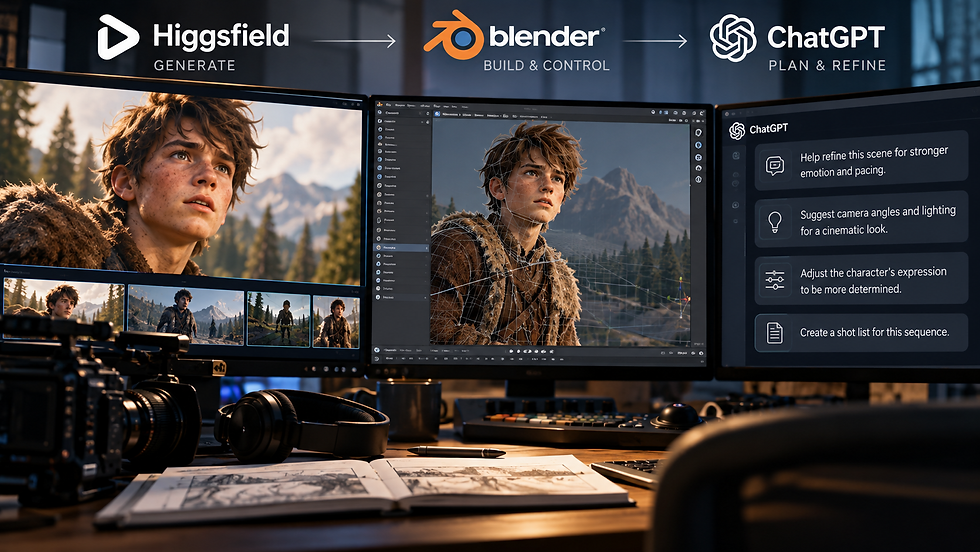
Generative AI systems are then used to create some of the film's imagery.
The director selects footage, makes substantive creative modifications, and works with an editor to assemble the final motion picture.
In this situation, the screenplay and other sufficiently original human-authored contributions may qualify for copyright protection. The filmmaker's creative selection and arrangement of material may also be protectable.
But that does not necessarily mean every individual AI-generated shot is protected.
Copyright protection can extend to the filmmaker's original creative expression without extending to all the AI-generated components used to create the film.
The precise scope of protection depends on the circumstances of the production.
The 2025 court decision that clarified the issue
On March 18, 2025, the United States Court of Appeals for the District of Columbia Circuit decided Thaler v. Perlmutter.
The case concerned an artwork generated by an AI system called the Creativity Machine. The copyright application identified the AI system as the sole author.
The Copyright Office refused registration, and the federal appeals court upheld that decision.
The court concluded that the Copyright Act requires human authorship.
Some discussions of the decision have suggested that AI-created material cannot receive copyright protection under any circumstances.
That interpretation is too broad.
The court was considering a work attributed entirely to an AI system. It did not decide whether a film incorporating substantial original human creative contributions could receive copyright protection.
In fact, that distinction is central to the Copyright Office's own guidance.
Does directing an AI system count as authorship?
This is where the legal questions become particularly interesting for filmmakers.
A director working with generative AI may specify camera angles, lighting, blocking, character movements, and emotional performances.
But the Copyright Office has concluded that simply providing prompts, using the technologies examined in its 2025 report, generally does not establish sufficient control over the resulting expressive elements.
Writing a detailed description of a desired image is not necessarily the same as creating that image's protectable expression.
That does not make prompting irrelevant to filmmaking. It means the legal analysis must consider what the filmmaker actually contributed to the finished work.
A director may exercise creative control through multiple stages of production, including writing, visual development, modification, selection, and editing.
Whether those activities produce copyrightable authorship must be evaluated on their merits.
As AI tools offer increasingly precise control over generated images and performances, these distinctions will remain important.
We will explore the relationship between prompting, directing, and creative control in Episode 2.
Why this matters to professional filmmakers
Copyright is not simply an administrative consideration.
It can affect distribution, licensing, financing, and the long-term commercial value of a motion picture.
A producer seeking distribution must understand which elements of a film are protected, which rights the production controls, and whether any third-party permissions are required.
AI-assisted productions add another layer to that analysis.
For example, a generative AI platform may grant permission to use its outputs commercially. That permission does not necessarily establish that the outputs themselves qualify for copyright protection.
Similarly, copyright protection for a completed film does not automatically resolve questions involving licensed music, synthetic voices, or a person's likeness.
These are separate legal considerations that producers must evaluate.
The importance of human creative control
For filmmakers, the practical lesson is not to avoid artificial intelligence.
It is to recognize that the human creative contribution remains central to copyright protection.
Screenwriting, original character development, creative editing, and other forms of human expression may establish protectable authorship.
Maintaining records of those contributions can also help explain the creative process when seeking copyright registration or documenting rights for a distributor.
Such records do not automatically establish copyrightability, but they can provide useful evidence of the human work behind the finished film.
The future of AI-assisted filmmaking
Generative AI is transforming motion picture production, but it has not eliminated the role of the filmmaker.
A compelling film still depends on creative choices about story, character, performance, visual composition, rhythm, and emotional impact.
At Journeyman Entertainment, we view AI as an evolving collection of production tools that can expand what filmmakers are able to create.
The legal framework is evolving alongside those tools.
For now, the central principle is clear:
AI can assist in creating a motion picture. Copyright protection still depends on human authorship.
Understanding that distinction is the first step toward producing AI-assisted films with a sound intellectual-property foundation.
Coming next: Episode 2 (October 16, 2026)
When Does Prompting Become Directing? The Human Authorship Question

We'll examine how creative direction, shot construction, editing, and control over AI-generated performances may affect the copyrightability of AI-assisted filmmaking.
Sources
This article discusses U.S. copyright law and policy as of October 2026 and is provided for general information, not legal advice. Individual productions should seek qualified legal guidance regarding copyright registration, licensing, and distribution.
Comments