When Does Prompting Become Directing? The Human Authorship Question.


For more than a century, film directors have exercised creative control over the images and performances that appear on screen. They select camera angles, compose shots, establish lighting, direct actors, determine pacing, and shape the emotional experience of an audience.
Today, generative artificial intelligence is changing how many of those decisions are executed.
A filmmaker can describe a complex camera movement, specify a character's performance, establish a lighting scheme, and generate a moving image without a physical camera, crew, or location.
But a fundamental question remains:
When does prompting an AI system become directing a film? And when does that direction constitute copyrightable human authorship?
The answers are related, but they are not necessarily the same.
The Difference Between a Prompt and a Directorial Decision
Consider two approaches to generating a cinematic scene.
In the first, someone enters:
"Create a dramatic scene of a man riding through an autumn forest."
The AI system makes most of the expressive decisions. It determines the framing, lighting, composition, movement, and much of the scene's visual character.
Now consider a different approach.
A filmmaker specifies the character's appearance, the precise camera position, lens focal length, direction of movement, lighting continuity, physical performance, eyelines, and timing.
The filmmaker reviews the generated footage, rejects unsuccessful takes, modifies the instructions, adjusts the composition, and repeats the process until the desired performance and visual result are achieved.
Finally, the filmmaker selects particular shots, determines their order, creates the transitions, adjusts timing, adds sound, and constructs a completed sequence.
From a production standpoint, that second process begins to resemble directing.
But does the law see it that way?
What the U.S. Copyright Office Says
In January 2025, the U.S. Copyright Office released Copyright and Artificial Intelligence, Part 2: Copyrightability, examining whether and under what circumstances AI-generated material can receive copyright protection.
Its central conclusion was that copyright protection requires sufficient human authorship.
The Office concluded that prompts alone, with the generally available technology it examined, do not provide sufficient control over generated expression. A more elaborate prompt does not automatically make the user the author of the resulting imagery.
However, human-authored material that remains perceptible in an AI output, sufficiently creative human modifications, and creative selection, coordination, or arrangement may qualify for protection. The assessment is case-specific, and protection for those contributions does not automatically extend to every generated element.
These distinctions come from the Office's January 2025 report, Copyright and Artificial Intelligence, Part 2: Copyrightability.
This distinction is crucial.
The question is not simply how much effort a filmmaker invests. It is which expressive elements of the finished work the human actually determines.
A filmmaker might spend hours refining a prompt without gaining copyright protection in the resulting image itself. Conversely, the filmmaker's original screenplay, creative editing, soundtrack, and sufficiently original arrangement of footage may contribute protectable authorship to the completed motion picture.
The presence of AI-generated footage does not automatically make the entire film ineligible for copyright protection.
Directing Is More Than Describing an Image
Traditional film direction is not merely the act of telling someone what to photograph.
It is a process of creative judgment.
A director interprets a screenplay, chooses how the audience receives information, shapes performances, establishes visual relationships, and determines how individual moments contribute to a larger narrative.
Generative AI filmmaking can involve many of these same creative decisions.
For example, a filmmaker may determine that a character should first notice a distant animal in a wide shot, followed by a telephoto closeup that reveals the animal's reaction.
The filmmaker might specify the direction of camera movement, the relationship between the subject and background, the precise moment of an editorial cut, and the emotional significance of the reaction.
Those are recognizable directorial decisions.
But the Copyright Office distinguishes between a human's creative intentions and the expressive details actually produced by the AI system.
A detailed instruction can communicate an artistic vision without necessarily establishing that the human authored every visual element the system generates.
This is where the legal analysis becomes more complicated.
The Importance of Creative Control
The critical issue is control over expression.
In conventional filmmaking, a director works through actors, cinematographers, production designers, editors, and other creative collaborators. The director does not personally execute every element of the production.
AI filmmaking raises an interesting comparison.
When a filmmaker specifies a camera movement or directs a character's expression through a generative system, the software performs tasks that might otherwise involve several human collaborators.
Yet there is an important legal distinction: human creative collaboration and autonomous AI generation are not necessarily treated alike for purposes of authorship.
A generative model may independently determine substantial visual details that were never specified by the filmmaker.
Consequently, the fact that a filmmaker directed the overall process does not, by itself, establish copyright in all of the generated footage.
The more useful question is whether identifiable, original human expression survives in the final work.
That expression might be found in the human-written screenplay, original artwork incorporated into a scene, substantial creative modifications, or the filmmaker's original selection and arrangement of shots.
Why Editing May Be Especially Important
Editing is one of the clearest examples of creative authorship in motion pictures.
An editor determines what the audience sees, when it sees it, how long an image remains on screen, and how one shot changes the meaning of another.
Imagine a filmmaker generates twenty versions of a scene.
The filmmaker selects four shots, trims them to precise lengths, arranges them into a sequence, establishes eyeline continuity, creates a dramatic pause, and cuts to a reaction at a carefully chosen moment.
The individual AI-generated clips may contain elements that are not independently copyrightable.
But the filmmaker's sufficiently original selection, coordination, and arrangement of those clips may constitute protectable authorship.
This does not automatically extend copyright protection to every underlying image.
It does, however, illustrate why the finished motion picture must be evaluated as more than a collection of AI-generated files.
The Emerging Role of the AI Film Director
Professional AI filmmaking increasingly requires a combination of traditional filmmaking knowledge and new technical skills.
Directors must understand cinematography, blocking, performance, visual continuity, production design, editing, and sound.
They must also learn how generative systems interpret instructions, where those systems fail, and how to maintain creative consistency across independently generated shots.
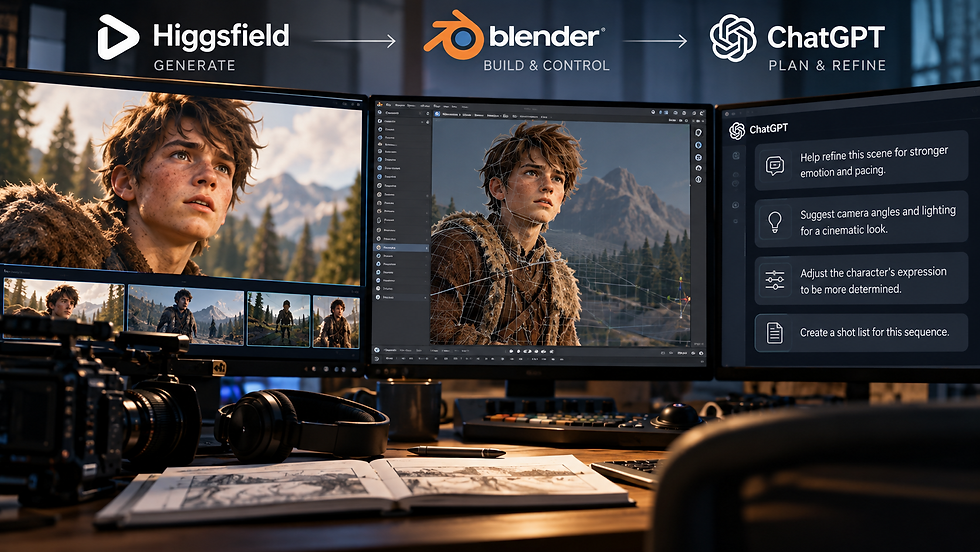
Applications such as Higgsfield, Blender, Adobe Premiere Pro, Topaz Video AI, and ElevenLabs can participate in different stages of this process.
The technology changes how the work is executed. It does not eliminate the need for artistic judgment.
But creative sophistication and copyright eligibility remain separate questions.
A filmmaker can be directing in the professional and artistic sense without necessarily owning copyright in every AI-generated frame.
That distinction deserves serious attention as the industry develops.
Documenting the Human Contribution
For filmmakers developing AI-assisted motion pictures, careful production documentation is increasingly important.
Useful records may include original screenplays, storyboards, character designs, shot plans, source artwork, generated versions, editorial timelines, sound design decisions, and documentation of substantial creative modifications.
For PAUL BUNYAN, we have added a Production Log in Obsidian that automatically records all production decisions, including their date, origin, use, continuity implications, and resulting output, helping us trace our creative contributions through to the finished film. We'll take a closer look at that process in episode 3.
Prompt histories can help establish the filmmaker's creative process, but they should not be mistaken for automatic proof of copyright ownership.
The most important documentation identifies what the human creator actually contributed to the finished work.
Keeping drafts and editable project files helps us explain that contribution. Documentation records the creative work; it does not create copyright where the contribution itself falls short.
When registering a work containing AI-generated material, applicants must also follow applicable Copyright Office disclosure requirements and accurately identify the human-authored contributions being claimed.
This is not simply an administrative issue. Clear documentation can also become important when preparing a film for financing, licensing, insurance, or distribution.
So When Does Prompting Become Directing?
From a filmmaking perspective, prompting begins to resemble directing when the creator moves beyond requesting an image and starts making coordinated artistic decisions about performance, camera placement, composition, movement, timing, and narrative meaning.
But there is no established legal threshold at which increasingly detailed prompting automatically becomes copyrightable direction.
The U.S. Copyright Office evaluates human authorship based on the expressive contribution reflected in the finished work, not simply the complexity of the instructions used to generate it.
That leaves filmmakers with both an opportunity and a responsibility.
Generative AI can expand the ability of individual creators to produce sophisticated cinematic work. At the same time, filmmakers must understand that artistic direction, technical effort, and legal authorship are not interchangeable concepts.
For our production, the useful question is: what did we actually author in the finished film? We should be able to point to our original screenplay, creative editing, compositing, sound design, and other expressive contributions, rather than merely count the prompts or hours spent.
The future of AI filmmaking may depend less on who can write the most elaborate prompt than on who can exercise the most meaningful creative control over the completed film.
The essential question is not whether a machine helped create the images. It is what the human filmmaker actually authored.
This is Part 2 of Journeyman Entertainment's six-part series, AI Filmmaking & Copyright, examining the creative, legal, and production challenges of professional AI-assisted filmmaking.

Coming next: Protecting Your AI Film: Copyright Registration and Creative Documentation.
This article discusses general U.S. copyright principles and is not legal advice.

Comments